University of Oregon Environmental Leadership Program Restoration and Research 2024
Our team stewards an ongoing Restoration and Research project at Whitewater Ranch in Leaburg, Oregon, in partnership with the University of Oregon's Ponisio Lab. We restore and manage riparian zones along Goose Creek, monitor pollinator populations following the Holiday Farm Fire, track native species health, and prepare the groundwork for future ELP groups continuing this work beyond 2015.


Team Photo
Environmental Leadership Program
The Environmental Leadership Program at the University of Oregon is a community-based program offering undergraduates hands-on experience through partnerships with organizations, agencies, and businesses, addressing local environmental issues while expanding students' academic and professional goals.
Our Work with Whitewater Ranch
Whitewater Ranch is an organic blueberry farm in Leaburg, Oregon, situated along the McKenzie River at roughly 700 feet elevation. The property encompasses forested, agricultural, and riparian habitats, with Goose Creek, a McKenzie tributary, serving as the primary site for our research and restoration, continuing past ELP work at the ranch.
Riparian Restoration
We monitored the growth and survival of plants established by past restoration teams, tracking height, health, and signs of disease, grazing, or competition. Each plant was recorded as dead, alive, or damaged, with notes on damage type and competing species. Photo points documented Goose Creek's progression over time, and newly planted species were measured to provide baseline data for future teams.


Water Quality
We monitored water quality at three sites along Goose Creek and one on Trout Creek, which now serves as a post-Holiday Farm Fire recovery reference. At each site, we recorded water depth and temperature, holding the probe for 60 seconds to standardize data collection. Water temperature is a reliable indicator of aquatic habitat health, as elevated temperatures signal poor conditions for aquatic biota.
Pollinator Pockets
Past ELP teams planted "pollinator pockets" along Goose Creek, concentrated groupings of native flowering species that support pollinators and distribute ecosystem services across the farm. We monitored the health and success of these existing pockets to inform restoration decisions, then used that data to design our own pollinator pocket for 2024.

The Ponisio Lab, led by Dr. Lauren Ponisio within the University of Oregon's Institute of Ecology and Evolution, researches pollinator survival in forests following fire or harvest. In partnership with ELP and Whitewater Ranch, the lab monitors native wildflowers planted among former burn piles to explore relationships between wildfire disturbance, timber collection, riparian health, and pollinator recovery.

Data Collection
Following the Holiday Farm Fire, the Ponisio Lab established plots in former burn sites across Whitewater Ranch's upland region. We monitored these plantings by identifying species and measuring percent cover, individual counts, and bloom numbers across subplots. Tracking presence-absence across roughly 20 paired plots seeded in 2021, we identified which species thrived and which did not, helping the Ponisio Lab and Whitewater Ranch determine the best species for future burn site restoration.
Pollinator Surveys
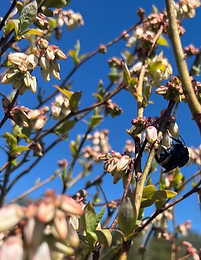
Pollinator surveys were conducted in pairs or small groups, with designated roles for observing, recording, and timekeeping. Each surveyor walked four 60-meter transects through the blueberry fields at a 3-meter-per-minute pace, completing each transect in 20 minutes. Temperature and wind speed were recorded before and after each survey, which was conducted twice during our time at the ranch. Pollinators were recorded only upon contact with the reproductive part of the blueberry, and included honeybees, bumblebees, carpenter bees, mason bees, flies, and bee-flies.
Final Report

Final Presentation

Final Scientific Poster
